
Homemade Weed Killer-Does it really work?
With all the news lately of weed killer being found in breakfast cereal, I know that it isn’t something I want in my food. I also don’t want to use it around my own garden. Searching for alternatives, I came across a popular recipe that seems to be circulating all over the web.
But does homemade weed killer really work? I decided to conduct some tests to find out. I’ve shared my results below.
Affiliate Disclosure: Please note that some of the links in this article may be affiliate links and I may receive a small commission if you purchase something through a link. It will not change your cost. As an Amazon Associate, I earn from qualifying purchases. For more information, see my disclosures page.)
While I would love to be able to pull up all the weeds that grow here, on our small farm that would be a full-time job. But I do want to protect my family and the environment. So I started researching more natural weed killers. And this recipe seemed to be the most popular.
- 1-gallon white vinegar
- 2 cups Epsom salts
- 1/2 cup dishwashing liquid
How I conducted my experiments
I picked a relatively sunny day in August to try my experiments and started early in the morning. Since I didn’t want to waste a lot of ingredients, I mixed up a small batch of the homemade weed killer.
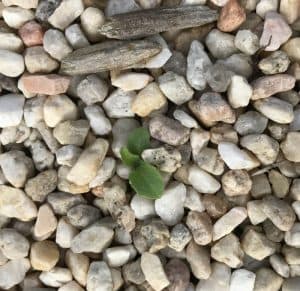
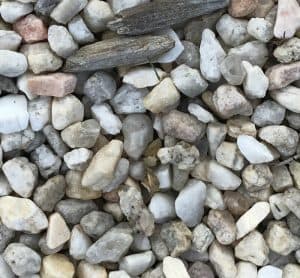
I sprayed the weed killer on various weeds, mainly dandelions and grass, and left it to do its work. I continued to check on the weeds throughout the day and photographed the areas I sprayed over the course of 2 weeks.
The results of my experiments were mixed. Small weeds seemed to be killed quickly, sometimes within a matter of hours.
But larger, older weeds managed to hang on. Several showed signs of stress within a day or two of spraying, but most larger weeds were growing again in two weeks.
Pros and Cons of Homemade Weed Killer
Here are some things to think about if you decide to use this weed killer around your own home. At the bottom of the post, I share the recipe I used and my thoughts on whether I will continue to use it.
Pros
- It worked quickly. Several hours later, the weeds were dry and brown.
- Seems to be effective on most weeds.
- Less toxic to the environment than most commercial weed killers.
Cons
- Is actually more expensive than store-bought weed killer concentrate.
- May require multiple applications, especially on difficult weeds.
- It really needs sunlight to be most effective. I had some difficulty getting it to kill weeds in the shade.
- Doesn’t kill some weeds all the way to the root.
- It is non-discriminatory-It will kill whatever it is sprayed on.
- You have to thoroughly saturate all the leaves on the weeds
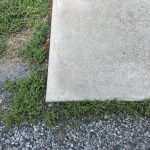
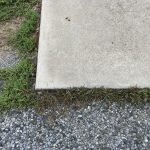
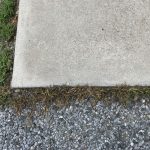
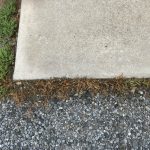
You can see in the pictures above that the weeds and grass looked pretty dead after just 4 hours. (The weeds on the left side of the concrete were purposely left as a control.) However, 2 weeks later, the driveway looked like this:
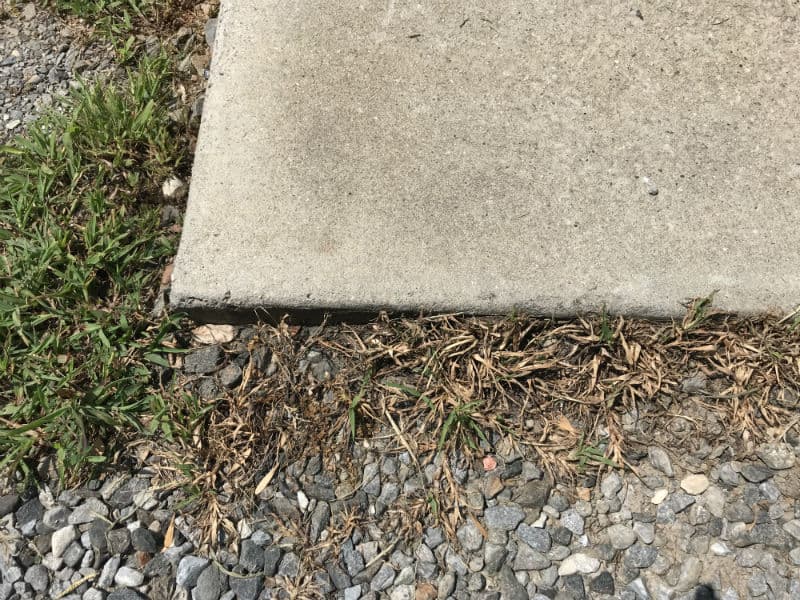
Yes, most of the weeds were gone, but some of the grass was starting to grow back. A second spraying seemed to take care of the grass just like before, but only time will tell if it comes back again.
A Few Warnings Before Using This Recipe
I spoke with a horticulturist to ask about the safety of using this homemade weed killer. She said that using it in large quantities or over-using it in one area can make the soil more acidic. This could make it difficult for good plants to grow. (If you’re wondering if your soil is acidic, learn how to do a soil test.)
For me personally, I have no problem if it makes my walkways acidic so nothing will grow. In my opinion, that is actually a benefit. But if you plan on using it in your garden or flower beds, be warned that using it too often can cause soil pH problems.
Homemade Weed Killer Recipe-2 Ways
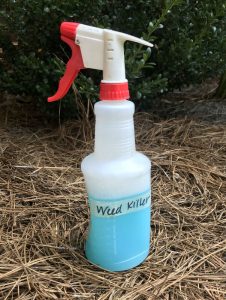
I’m sharing the recipe with you two ways. The large batch makes enough to fill a 1-gallon sprayer. If you want to experiment with a small amount first (like I did), the small batch will fit in a 24 oz. spray bottle.
Large Batch (Fits in a 1-gallon sprayer.)
1-gallon white vinegar
2 cups Epsom salts
1/2 cup dishwashing liquid
Small Batch (Fits in a 24 oz. sprayer bottle.)
16 oz. vinegar
1/3 cup Epsom salts
1 Tablespoon dish washing liquid
Would I Still Use It?
After testing this homemade weed killer, I will most likely continue to use it occasionally. We have a rock walkway leading to our front door, that seems to always grow weeds. (The pictures of the dandelion above were taken in that walkway.)
However several commenters have mentioned 30% vinegar that I would like to try soon. It is quite expensive though, so would not be suitable for spraying large areas, but it would definitely be a good solution for weeds in places that are difficult to reach.
I love that I can spray this on in the morning and by evening the weeds will be brown. I don’t have to wait a week for the weeds to die. This is especially helpful if we are having guests over soon.
However, I will be cautious where I use it and be careful not to spray it on anything I don’t want to kill.
Have you ever tried a homemade weed killer? Did you discover that it worked well or was it a total flop? I would love to hear about your experiences with it in the comments.
Related Posts
- How to use black plastic in your garden to control weeds.
- What you need to do to clean up the garden in the fall.
- How to prepare for storms when you homestead.
The link: Yes, I realize the irony that I am killing dandelions and my blog is named Dogwoods & Dandelions. Want to know why it’s called that? Read here
Doesn’t work …..I’d like to know why you call it that.
Thanks for letting me know the link was broken. That page no longer exists, but I do have a brief explanation at the bottom of my about page.
Really, there aren’t many actual “weeds” that need killing. Most “weeds” are actually valuable either medicinally or culinary and should NOT be killed! Dandelion, especially feeds bees and should NOT be killed as dandelions come out before other foods are available for the bees.
Most “weeds” here get eaten by the visiting deer (not that I like feeding them plants I’d like to harvest myself!) The only plants that I would use a natural pesticide on would be poison oak as I’m VERY allergic to it, and it IS around the perimeter of my property. I have used the 30% vinegar and salt in hot summer on it quite successfully.
Also, since Dawn dishwashing liquid is toxic and contains toxic ingredients, I would never even BUY it, less would I use it on my property…the ramifications of using it on my ground is that it would remain in the soil and cause other issues should I want to plant something there.
Seriously, I would give this post a thumbs down.……Sorry
Thank you for sharing your thoughts. I don’t typically kill dandelions, instead I use the flowers to make dandelion jelly. Yum.
You could definitely substitute the Dawn with another non-toxic dish detergent. There are many on the market now, that weren’t around when this post was originally published. I have updated the post to reflect this.
And of course, we have to remember that everyone is on a different journey to non-toxic living. This is still far preferable to commercial weed killers and most of my readers are not fortunate enough to be able to live a completely non-toxic lifestyle. (I don’t really think any of us can in this day and age.) So we all have to do what we think is best and as we learn more, we do better.
If you use 30% acidity vinegar, you will not have grow back. It’s available on Amazon. Caution should be used as it’s not a gentle vinegar and definitely not food grade.
Thank you for this tip. I had never heard of 30% acidity vinegar. This would be great for areas like walkways where you know you don’t want anything to grow.
I used this with success around my yard and garden! It definitely needs direct sunlight to work. Thank you for posting!
Thanks for letting me know it worked for you too! And I’m glad you confirmed that it needed sunlight to work.
I’m so impressed at all the before and after pictures! This looks like it works really great!
Thanks! I was really surprised at how well it worked. Our rock walkway is always a source of embarrassment to me when guests come over because there is always weeds in it and its the first thing they see. Now I can spray the weeds in the morning and they’ll be dead by evening!